

Choosing the wrong seal material causes immediate system failure. High temperatures melt standard rubbers while extreme cold makes them brittle. You must match your seal material to your specific operating environment to prevent fluid loss and pressure drops.
Industry data from 2024 shows that improper material selection accounts for 40% of all hydraulic component failures. As systems run hotter and faster, the margin for error stays slim. You need to know how Nitrile, Viton, and PTFE handle these stresses.
Nitrile Butadiene Rubber (NBR) for Standard Use
Nitrile remains the most common choice for hydraulic systems. It works well with petroleum based fluids and offers high resistance to abrasion. You should use Nitrile when your system operates within a moderate temperature range.
Temperature Limits of Nitrile
Standard Nitrile seals operate reliably between -40°C and 100°C. If your system exceeds 100°C, the material hardens. Brittle seals crack under pressure and cause leaks.
Best Applications for NBR
Use NBR for general industrial machinery and mobile equipment. It provides a cost effective solution for systems that do not face chemical aggression. Most off-road construction equipment relies on NBR for cylinder seals.
Viton (FKM) for High Heat Environments
Viton handles heat much better than Nitrile. This fluorocarbon elastomer maintains its shape and elasticity when temperatures spike. You choose Viton when you need long term reliability in hot environments.
Thermal Stability of Viton
Viton seals endure constant temperatures up to 200°C. They also resist chemical degradation from synthetic hydraulic fluids. According to a 2024 report by Market Research Future, the demand for FKM seals is growing at a rate of 5.2% due to increased thermal demands in aerospace and automotive sectors.
Chemical Compatibility Advantages
Viton resists most mineral oils and fuels. It prevents swelling which often leads to seal extrusion. You should select Viton if your system uses fire resistant fluids or faces high ozone exposure.
PTFE for Extreme Temperatures and Low Friction
Polytetrafluoroethylene (PTFE) is not a rubber but a plastic. It offers the widest temperature range of any common seal material. You use PTFE when your system faces temperatures that would destroy any elastomer.
Operating in the Extremes
PTFE operates from -200°C to 260°C. It does not become brittle in cryogenic conditions and does not soften at high heat.
Managing Friction and Wear
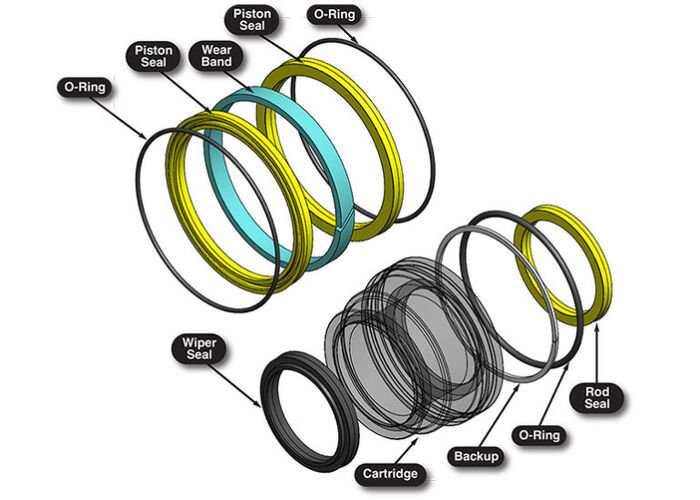
PTFE has very low friction. This prevents the "stick-slip" effect in hydraulic cylinders. Because PTFE lacks the "memory" of rubber, you often need a spring or an O-ring energizer to keep it tight against the sealing surface.
Comparing Material Performance and Costs
Selecting a material requires a balance between performance and budget. Nitrile costs the least but fails first in heat. Viton costs more but lasts longer in harsh conditions. PTFE carries the highest price tag but handles the most extreme environments.
"Selecting a seal material based solely on price leads to exponentially higher costs in downtime and repair," says Marcus Thorne, a Senior Fluid Power Engineer.
Factors Influencing Your Choice
Consider the fluid type, pressure levels, and temperature cycles. A system that cycles between extreme cold and high heat requires a material that remains flexible throughout the entire range.
Wear Resistance Trends
Recent manufacturing trends show a shift toward "filled" PTFE materials. Manufacturers add bronze or carbon to the PTFE to improve wear resistance in high pressure pumps. This extends the life of the seal by 30% compared to pure PTFE.
Knowing which material to specify is only half the battle, it needs to be sourced quickly to get your machinery back to work. FPD stocks over 600 hydraulic seal kits covering a wide range of excavators and mobile equipment, from 8 to 40-tonne machines, across all major manufacturers including Hitachi, Kobelco, Volvo, Hyundai, Sumitomo, and Cat. If your application falls outside standard kits, our team can work with you to have seals manufactured to specification. We aim to keep your down downtime to a minimum. Contact the FPD team with your machine model and component details, and we’ll confirm availability or get sourcing underway the same day.
Hydraulic Seals FAQ
Does FPD carry hydraulic seals in stock?
Yes, FPD carries a large inventory of seal kits ready to ship from our Hamilton warehouse.
Our stock covers seal kits for excavators from 8 to 40 tonne, across all major components:
- Cylinders — boom, bucket, and arm
- Drive and swing — swing motors and centre joints (swivels)
- Hydraulic circuits — main control valves and hydraulic pump seal kits
We supply seal kits for excavator brands operating in New Zealand, including Kobelco, Sumitomo, Hyundai, Hitachi, CAT, Volvo, Caterpillar, Doosan, Komatsu, Samsung, and Kato.
If you’re not sure whether we have the right kit for your machine, give us the make, model, and component details and we’ll confirm availability straight away.
How do I identify my current seal material?
Nitrile is usually black. Viton is often brown or green but can also be black. PTFE is typically white or grey and feels like hard plastic. Always check the part number to be sure.
Does hydraulic fluid type affect my seal choice?
Yes. Certain synthetic oils attack Nitrile and cause it to swell. Always check the compatibility chart for your specific fluid before buying seals.
Which seal material lasts the longest?
In a standard environment, all three can last years. In high heat, Viton outlasts Nitrile. In high speed applications, PTFE outlasts both due to its low friction.
What happens if I use Nitrile in a high temperature system?
The heat causes the rubber to undergo a process called cross-linking. The seal becomes hard and loses its ability to squeeze against the metal surface. This results in a persistent leak.
Can Viton work in extremely cold weather?
Standard Viton becomes stiff at -20°C. It may fail to seal until the system warms up. For cold climates, you need a specialized low temperature grade of Viton.
Why is PTFE often paired with a rubber O-ring?
PTFE is rigid. It cannot bounce back like rubber. The rubber O-ring sits behind the PTFE and pushes it against the shaft to maintain a tight seal.